Conference Dates: 28th August – 31st August 2025 Venue: Tourist Facilitation Centre, Kargil
Dear Conference Participants,
We wish to inform you that the final dates for the conference have been scheduled for the 28th August (starting midday, Inaugural dinner in the evening) until the 31st August 2025 (ending midday) to be held at the Tourist Facilitation Centre, Kargil.
The later start on the 28th should also enable people to arrive from Leh the same day to participate in the events. Likewise, the ending on the 31st at midday should give people the opportunity to return to Leh the same day.
We will update the website soon for accommodation and travel details.
Please be informed, that the deadline for the submission of abstracts has been extended until the 15th of April, 2025!
In addition, we created an informal document containing hints and tips how to write an abstract as well as create and hold a presentation at the IALS Conference. We hope this document can help especially first time presenters to have a smooth and enjoyable experience at our conference. You can download the document [HERE].
Further information on the conference can be found [HERE].
The passing of the writer and historian Abdul Ghani Sheikh leaves an immense gap in the lives of his family and innumerable friends as well as the wider Ladakh studies community. Born in 1936, he was himself a witness to history in that he had lived through the traumas of Partition in 1947 and the period of accelerating political and social change that followed. In his short stories and in his historical research, he wrote with insight and compassion. To many of us, he served as a mentor and a friend. Here I would like to share a note about his association with the IALS.
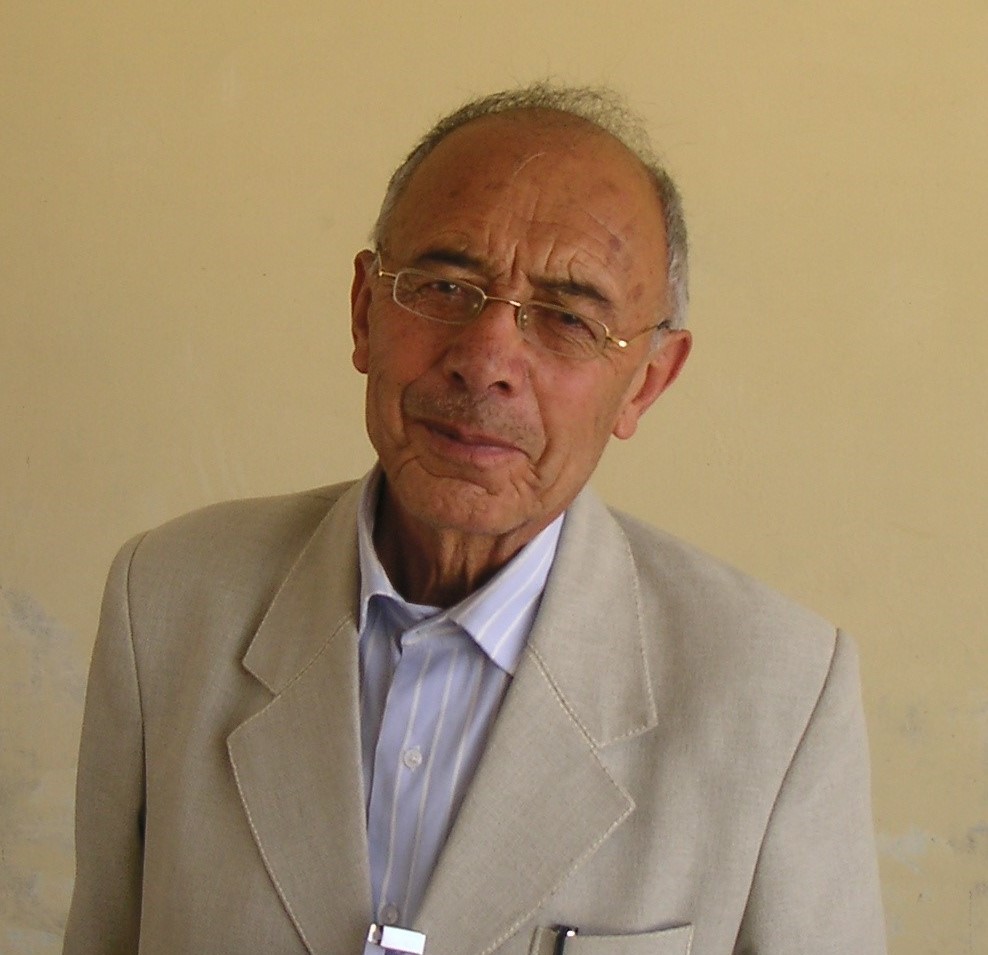
Abdul Ghani Sheikh in 2009
In 1989, Sheikh Sahib travelled to the UK for the IALS conference at the University of Bristol, which was organised by Dr Henry Osmaston. Although this was the fourth in the series of Ladakh studies conferences, it was the first to be held specifically under the auspices of the IALS. Sheikh Sahib presented a paper on “A Brief History of Muslims in Ladakh”. The other Ladakhi contributors in Bristol were Jamyang Gyaltsen, Dr Nawang Tsering, Nawang Tsering Shakspo, and Sonam Wangchuk (SECMOL).
Abdul Ghani Sheikh presenting in Bristol in 1989. John Bray on the left, Nawang Tsering Shakspo on the right.
Thereafter, Sheikh Sahib became a regular presenter at IALS conferences both in Ladakh and abroad. The last international conference in which he participated was in Rome in 2007. Always eager to expand his international horizons, he managed to stop over in Istanbul on the return journey and made contact with a Uighur friend who lived in Turkey but had long family associations with Ladakh.
Shiekh Sahib’s list of IALS publications is representative of his special interests. By virtue of his background, he naturally placed a particular focus on the history of Ladakhi Muslims and on Ladakh’s relationships with Central Asia and other neighbouring regions. However, he always took a broad view of Ladakhi society. His other writings included a biography of the Ladakhi Buddhist leader Sonam Norboo (1909-1980) and he often expressed appreciation for the contributions of the Moravian community.
Abdul Ghani Sheikh with Radhika Gupta at the IALS conference in 2009. Christian Jahoda and Kurt Tropper in the background.
In the early 2000s, Sheikh Sahib served as the Hon Secretary of the IALS’s Ladakh Committee. I particularly remember working with him to secure the participation of two Balti scholars, Syed Bahadur Ali Salik and Ghulam Hasan Hasni, at the IALS conference in Kargil in 2005. This involved writing invitation letters and supporting documentation to the Indian High Commission in Islamabad as well as the Pakistani High Commission in New Delhi and – at the very last minute – the then Indian Foreign Minister Natwar Singh. Eventually, we were successful but the two Baltis only arrived in Kargil on the very last day of the conference.
Over the years, many of us benefitted from the hospitality of Sheikh Sahib and his family at the Yasmin Guesthouse, now the Grand Yasmin Ladakh, near Fort Road. Whether at his home or in one of Leh’s restaurants and coffee houses, it was always a delight to meet him. He was consistently unassuming, always perceptive, sometimes quite sharp in his observations. We have lost one of the best of friends.
Abdul Ghani Sheikh’s publications under the auspices of the IALS
1995. “A Brief History of Muslims in Ladakh.” In Recent Research on Ladakh 4 & 5, pp. 189-192. Edited by Henry Osmaston and Philip Denwood. London: School of Oriental and African Studies; Delhi: Motilal Banarsidass.
1996. “Some Wellknown Adventurers of Ladakh.” In Recent Research on Ladakh 6, pp. 231-238. Edited by Henry Osmaston and Nawang Tsering. Bristol: Bristol University Press; Delhi: Motilal Banarsidass.
1997. “Ladakh’s Relations with Central Asia.” In Recent Research on Ladakh 7, pp.447-456. Edited by Thierry Dodin and Heinz Räther. Ulmer Kulturanthropologische Schriften Band 8. Ulm: Abteilung Anthropologie, Universität Ulm.
1999. “Economic Conditions in Ladakh during the Dogra Period.” In Ladakh: Culture, History and Development, between Himalaya and Karakoram. Recent Research on Ladakh 8, pp. 339-349. Edited by Martijn van Beek, Kristoffer Brix Bertelsen and Poul Pedersen. Aarhus: Aarhus University Press.
2007. “Transformation of Kuksho Village.” In Recent Research on Ladakh 7, pp. 163-170. Edited by John Bray and Nawang Tsering Shakspo. Leh: Jammu & Kashmir Academy of Art, Culture & Languages.
2009. “Kargil from the Perspective of Historical Travellers and Government Officials.” In Recent Research on Ladakh 2009, pp. 39-45. Edited by Monisha Ahmed & John Bray. Kargil & Leh: International Association of Ladakh Studies.
2009. “The Traditions of Sufism in Ladakh.” In Mountains, Monasteries and Mosques. Recent Research on Ladakh and the Western Himalaya, pp. 131-139. Edited by John Bray & Elena De Rossi Filibeck. Supplement No. 2 to Rivista degli Studi Orientali 80 (New Series). Pisa & Rome: Sapienza, Università di Roma, Dipartimento di Studi Orientali.
We have an update regarding the 20th IALS Conference, 2023. Many participants from India are unable to go and attend the conference at Heidelberg, due to a problem with their VISA application. Some of them received their VISA last minute and for a very short duration of time. Therefore, given the present circumstances, it was decided by the Conference Organising Committee with discussion with the Heidelberg University, that we should have a hybrid conference, where we plan to have presenters from Ladakh at one place and relay an online platform for the two days of conference presentations, i.e. 6th and 7th October, 2023, as per the original paper presentations schedule.
Unfortunately, we will only be able to ask only the presenters from the final programme to present their papers during the event. If any IALS members and other interested individuals wish to join us in Leh, we request you to register at ialsconference2023@gmail.com and confirm your participation for the event on or before the 4th October, 2023.The registration fee for two day conference 6th & 7th October, 2023, is Rs. 1000/- for individuals, and Rs. 500/- for students.
Since we have limited seating capacity of 15-20 individuals, we will confirm participation on ‘First Come, First Serve’ basis. Please do email us before the 04th October, as we need to order catering in advance.
For online participation, we will also provide an online link for students and others interested.
Because of a very long waitlist for Schengen visa appointments due to the aftermath of COVID travel restrictions, participants from India would not have been able to receive their visas in time for the conference in June.
Therefore, the conference has to be postponed to 05th – 08th October 2023!
To all participants fromoutside the EU: Apply way ahead of time for your Schengen visa. The time until you receive your visa might take up to 4(!!) months at the moment!
Neil and Kath Howard with Erberto Lo Bue (left), Rome 2007.
Neil Howard, who passed away in January 2023, was an independent researcher specialising in the study of the military and architectural history of Ladakh.
Neil came late to the study of Ladakh and by chance. In the course of a trek through Ladakh in the early 1980s, he and his wife Kath noticed the many ruined forts above the region’s villages. Finding that little had been written about them, he decided to do the research himself. His first major publication was an article on the development of Ladakh’s military architecture, which appeared in the Italian journal East and West in 1989, and this is still an important reference source. His initial work on forts led naturally to further study on military campaigns in Ladakh, notably the invasion by Mirza Haider Dughlat in the 1530s and the Dogra invasion three centuries later. He also extended his geographical range to include Lahul and Kangra.
All Neil’s work shows the same qualities. Perhaps most importantly, his architectural and archaeological studies were based on careful on-the-ground observation. He weighed up the evidence as he saw it, and pushed his analysis as far as he reasonably could, but no further. Later, he worked with other colleagues, notably Philip Denwood of the School of Oriental and African Studies (London), to assess the written sources that might shed further light on his chosen themes.
I myself retain a happy memory of an occasion when I was able to perform a service as Neil’s research assistant. In 2005, together with our colleagues Abdul Ghani Sheikh and Ken Macdonald, I made an excursion to photograph the chortens and castle ruins of Gya. These later contributed to Neil and Kath’s article on Gya that appeared in 2014 (see bibliography).
Although Neil did most of the writing and much of the talking, he worked with Kath as a husband-and-wife team both on mountain treks and, later, on the conference circuit. Always forthright in his views on life’s ironies, he was generous and supportive in his friendships. In later years, he took pleasure in the publications of younger scholars who have deepened and extended his own research findings. His own carefully calibrated pioneering work remains an example to follow.
Publications
1984. “Castles of the Himalayas.” Popular Archaeology, April 1984, pp. 12-19. Hemel Hempstead.
1987. “Royal Fortresses of Ladakh.” Archaeology Today, May 1987, pp. 29-35. Frome, England.
1989. “The Development of the Fortresses of Ladakh c.9501650 AD.” East and West 39, Nos. 14, pp. 217-288. Rome: Istituto per il medio ed estremo oriente.
1990. “Inscriptions at Balukhar and Char Zampa and General Archaeological Observations on Balukhar Fort and its Environs.” With Philip Denwood. In Indo-Tibetan Studies: Papers in honour and appreciation of Professor David L. Snellgrove’s contribution to Indo-Tibetan Studies, pp. 81-88. Edited by Tadeusz Skorupski. Tring: Institute of Tibetan Studies.
1992. “The Dogra Forts in Greater Ladakh, North-west India.” Fort 20, pp. 7186.
1994. “The Trekking Route up the Tsarap River, Zangskar.” Ladakh Studies 7, pp. 9- 10.
1995 (a). “The Fortified Places of Zanskar.” In Recent Research on Ladakh 4 & 5, pp. 79-99. Edited by Henry Osmaston and Philip Denwood. London: School of Oriental and African Studies; Delhi: Motilal Banarsidass.
1995 (b). “Military Aspects of the Dogra Conquest of Ladakh 18341839.” In Recent Research on Ladakh 4 & 5, pp. 349-361. Edited by Henry Osmaston and Philip Denwood. London: School of Oriental and African Studies; Delhi: Motilal Banarsidass.
1996 (a). “What Happened Between 1450 and 1550 AD? And Other Questions from the History of Ladakh.” In Recent Research on Ladakh 6, pp. 121-138. Edited by Henry Osmaston and Nawang Tsering. Bristol: Bristol University Press; Delhi: Motilal Banarsidass.
1996 (b). “Chronology of the Travels of G.T. Vigne in the Western Himalaya, 1835-1839 Ladakh Studies 8, pp. 27-30.
1999. “Ancient Painted Pottery from Ladakh.” In Ladakh: Culture, History and Development, between Himalaya and Karakoram. Recent Research on Ladakh 8, pp. 222-236. Edited by Martijn van Beek, Kristoffer Brix Bertelsen and Poul Pedersen. Aarhus: Aarhus University Press,
2002. “The Political Geography of South-east Zanskar, and a Reconsideration of the Royal Chronologies of Zanskar and Ladakh in the 15 th Century.” South Asian Studies 18, pp. 91-108. London: Society for South Asian Studies.
2005 (a). “Sultan Zain-ul Abidin’s Raid into Ladakh.” In Ladakhi Histories. Local and Regional Perspectives, pp. 125-145. Edited by John Bray. Leiden: Brill.
2005 (b). “The Development of the Boundary between the State of Jammu & Kashmir and British India, and its Representation on Maps of the Lingti Plain.” In Ladakhi Histories. Local and Regional Perspectives, pp. 217-234. Leiden: Brill.
2007. Things to do in Leh. A jeu d’esprit. Self-published pamphlet for private circulation.
2009. “Prince Peter’s Journey from Manali to Ladakh, 5 th June–22 nd August 1938.” In Recent Research on Ladakh 2009, pp. 55-71. With Poul Pedersen. Edited by Monisha Ahmed & John Bray. Kargil & Leh: International Association of Ladakh Studies.
2012. “The Tak House Maitreya and Some Corrections of the Later History of Ladakh.” Ladakh Studies 28, pp. 36-38.
2014. “Historic Ruins in the Gya Valley, Eastern Ladakh, and a Consideration of Their Relationship to the History of Ladakh and Maryul. With Kath Howard and an Appendix on the War of Tsede (rTse lde) of Guge in 1083 CE by Philip Denwood.” In Art and Architecture in Ladakh. Cross-Cultural Transmissions in the Himalayas and Karakoram pp. 68-99. Edited by Erberto Lo Bue and John Bray. Leiden: Brill.
2016. “Castles and Defensive Architecture in Purig: an Introduction, Survey and Preliminary Analysis.” In Visible Heritage. Essays on the Art and Architecture of Greater Ladakh, pp. 85-112. Edited by Rob Linrothe and Heinrich Pöll. New Delhi: Studio Orientalia.
2020. “The defences of Basgo revisited.” Études mongoles et sibériennes, centrasiatiques et tibétaines. With Quentin Devers. Online publication : http://journals.openedition.org/emscat/4257.
Forthcoming. “The Portal of the Leh Palace.” With Gerald Kozicz. Awaiting publication.


 International Association for Ladakh Studies (IALS)