Quarantine, social distancing and historical epidemics in Ladakh and the Western Himalaya

By John Bray

Historically, neither infectious diseases nor quarantine are new to Ladakh or the wider Himalayan region. At first sight, this is a depressing topic for research. However, closer examination points to encouraging evidence of human ingenuity. Above all, it reminds us – if any reminder is needed – of the benefits of modern medical care.

Some of the most vivid source material concerns smallpox. Dr Henry Cayley (1834-1904), a member of the Indian Medical Service, was the first fully-trained Western doctor to work in Ladakh: he came to Leh in 1867 as a British “officer on special duty” and ran a clinic alongside his main work, which was to monitor the Central Asian trade routes. He wrote that he saw no case of smallpox in that year but that “ten years ago it spread through the whole country, and killed numbers”. He goes on to explain that the Ladakhis had practised a stark form of social distancing:

In former years the custom was to expose the patients with the disease out on the mountain sides, where the friends brought them food, &c. until they either died or got well. It was a somewhat cruel, but, at the same time, admirable, plan for lessening the spread of the disease: and in this climate it would really be better for the sick to be out in the open air, than shut up in a close dwelling.

On a happier note he reported that the whole population had been “inoculated by the Lamas” during that period. Since then, the disease had not occurred, except for a few cases in 1866, and the dread of the disease had greatly diminished.

It is not clear precisely what Cayley means by “inoculation”. In the late 18th century the British doctor Edward Jenner had pioneered the process of cowpox vaccination. The East India Company veterinarian William Moorcroft, who visited Ladakh in 1820 and 1821, tried to introduce vaccination against smallpox, but was unsuccessful because he was unable to obtain a sufficient quantity of active vaccine from his friends in India. Meanwhile, as Lobsang Yongdan (2016) has shown, the Tibetan scholar Jampel Tendzin Trinlé (1789-1839), widely known as ‘Tsenpo’, wrote about vaccination in Jenner’s sense, as early as the 1830s. However, the Ladakhi lamas who were inoculating in the 1850s may have been practising variolation, a technique whereby doctors immunize an individual against smallpox with material taken from a patient in the hope that a mild but protective infection would result.

In any case, both Western and local practitioners combined to spread knowledge of Jennerian vaccination in the Western Himalayan region from the mid-19th century onwards.

Another example from 1867, the year that Cayley was writing from Ladakh, concerns the Moravian missionary Eduard Pagell (1820-1883) who served in Pooh, Kinnaur. In February 1867 a messenger from the Totso valley in the neighbouring region of Western Tibet arrived to say that the area was suffering from a smallpox epidemic, which had already wiped out several families. He asked the missionary to come to their aid or no one would be left at all.

Pagell had himself been sick in bed for three days but he duly sent out on the five-day journey to Totso. In one village of 23 houses, 60 people had caught the disease and all but a few had died. In another place, those infected by the disease had taken refuge in a cave some distance away – following the same ‘quarantine’ technique as the Ladakhis – where they languished without any care at all. Pagell gave what help he could, visiting 12 villages and vaccinating 639 people.

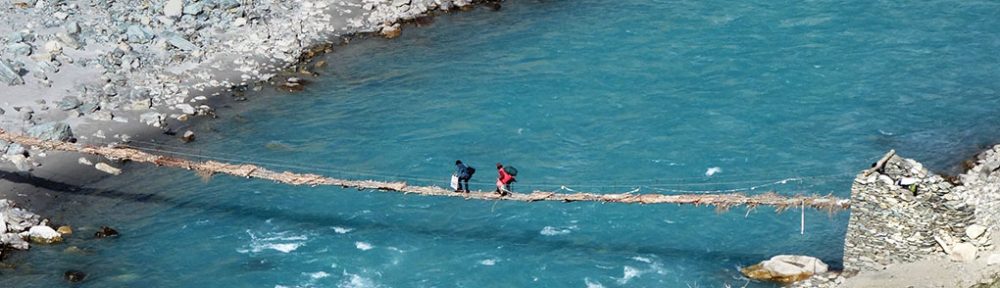
On this emergency visit, Pagell, was welcomed wherever he went and many of his patients recovered but he was never able to repeat the journey. When he tried to do so in the summer of 1867, he found that the Tibetans had broken bridges on the main paths and placed watchmen at the border with orders to shoot anyone who tried to enter the country from Kinnaur: the whole country was in quarantine.

In Ladakh, both the knowledge and the practice of vaccination continued to spread. In 1880 British Joint Commissioner Ney Elias (1844-1897) reported that a monk named Sonam Tandup had made a practice of obtaining smallpox vaccine from the British dispensary. Travelling from place to place during a great part of the year, he had conducted 634 vaccinations in 1877, 347 in 1878 and 445 in 1879. He received no salary, and Elias suggested that he should be given Rs 15 for his work over the previous year.

Today, we again need to implement quarantine and social distancing but smallpox belongs to the past. One day – we hope soon – Covid-19 will likewise be a distant historical memory

References

Bray, John. 2015. “Dr Henry Cayley in Ladakh: Medicine, Trade and Diplomacy on India’s Northern Frontier.” In Tibetan and Himalayan Healing. An Anthology for Anthony Aris, pp. 81-96. Edited by Charles Ramble and Ulrike Roesler. Kathmandu: Vajra Books.

______.1992. “Christian Missionaries on the Tibetan Border: the Moravian Church in Poo (Kinnaur), 1865-1924.” In Tibetan Studies, pp. 369-375. Edited by Shoren Ihara and Zuiho Yamaguchi. Narita: Narita Institute for Buddhist Studies.

Lobsang Yongdan. 2016. The Introduction of Edward Jenner’s Smallpox Vaccination to Tibet in the Early 19th Century. Archiv Orientální 84: 577-593.

Wikipedia. “Variolation”. http://en.wikipedia.org/wiki/Variolation

Letter to the Members from IALS President Sonam Wangchok concerning COVID-19 / the Corona Virus

Dear IALS Members,

I hope everyone is keeping well and taking all the precautionary measures seriously at wherever you are to combat the COVID-19 outbreak. The Coronavirus has reached most of the countries on earth and it has upended life across the globe, shutting down entire cities and countries in a matter of months. It is the most likely scenario that this situation may take possibly more days and months. It is being reported that more cases of Coronavirus pandemic are now being recorded outside of China, where the virus was first detected in the central city of Wuhan. In this situation I appeal you all to stay strong and fight the COVID-19 outbreak by taking all precautionary measures. During this difficult time, it’s important to continue looking after your physical and mental health. This will not only help you in the long-term, it will also help our administrations and hospitals to fight the virus.

Like other countries and states, Ladakh has also witnessed 13 positive cases connected to pilgrims returning from Iran. Among them three declared completely cured in last few days. My heartfelt admiration goes to Ladakh administration and the health fraternity who work day and night in such difficult circumstances in the service of humanity.

At the moment, we are under complete lockdown for three weeks but we strongly believe that we’ll get through this together at the earliest. We can see the sun is shining, the sky is clear and apricot and apple trees are all set to blossom in Ladakh.

Stay safe, stay calm, be vigilant and most importantly remember prevention is better than cure.

Please take care everyone.

Sonam Wangchok
President, IALS

IALS Minutes of the General Meeting and Updated Membership Fees

Dear IALS members,

please find the minutes of the general meeting held after the 19th IALS conference in Leh here.

As mentioned in the minutes membership fees were changed to better reflect current exchange rates and socio-economic changes since the old rates were installed. In addition IALS now offers 6 and 10 year memberships to a 10% discount from the normal rates. As before all information can be found under our Membership section.

IALS Election Results and Conference Report

The results of the 2019 election for the Executive Committee of IALS:

President:

Sonam Wangchok [Elected unopposed]

Membership Secretary/Treasurer:

Lauren Smyth [Elected unopposed]

For the other posts, a total of 65 ballots were cast at the conference (45) and by email 20). Of these three were disqualified as two were received after the deadline and one was cast by a lapsed member. The final results are:

Secretary

Amjad Ali [2]
Elizabeth Williams-Oeberg [22]
Judith Muller [13]
Konchok Dorjey [12]
Nazir Hussain [13]

Elizabeth Williams-Oeberg with 22 votes is the new secretary of IALS.

Ladakh LIaison Officer

Fayaz Ali [23]
Muzammil Hussain [9]
Tsewang Rigzin [29]

Tsewang Rigzin with 29 votes is the new Ladakh Liaison Officer of IALS.

Compiled and overseen by Election Officers, Rigzin Chodon and Sunetro Ghosal

The report of the 19th IALS Conference in Leh can be downloaded here

IALS Elections Update

The members of the Executive Committee and Advisory Committee of IALS met in Leh on 1 September, 2019 on the sidelines of the IALS conference currently underway. At this meeting it was decided to follow the spirit of the IALS conference and provide the members who were not able to attend the conference to cast their vote for the positions that are currently up for election. It was also decided that the final result of the election will not be declared till email votes have been counted.

Thus, the members who are at the conference will cast their vote in person at the conference. Through this post and through email being sent to all members, we are opening the election to all members. Please use the official ballot to cast your vote. The other PDF provides information on who have been nominated. You will notice that the position of Secretary and President do not appear in the ballot sheet as only one person has been nominated for each position and are elected unopposed.

You can find the election ballot here and the list of nominations here.

You will need to fill in your name on the ballot and any sheet without a name will not be counted. We assure you that your choice will not be disclosed to anyone and your name is only being recorded to ensure that there is no double voting and all voted are cast by members. The email ballots have three editable spaces for you to type your name, and pick a candidate for each position. You do not need to print the ballot our. You can fill it on your computer.

Please ensure that you are a member of IALS and have not voted at the conference. The ballot will be disqualified if you are not a current member or have already voted.

Please send all your queries and completed ballots to editor@ladakhstudies.org. . 
The deadline for receipt of email votes is 23:59 hours on 17 September, 2019. The final result of the elections will be announced after these votes have been counted and added to the tally of the votes cast at the conference. .

Thank you

Sunetro Ghosal and Rigzin Chodon
Election Officers 2019 IALS

Conference Update 24/08/2019: Update Conference Programme & Contact and Transportation Information

Please find attached the final schedule of the IALS 2019 Conference, including several changes and additions to the previous draft: IALS Conference Programme

We also uploaded contacts and local transportation offers. Especially the hired bus going from Leh to the conference location and back every day might be of interest. Please find more details here: Contacts and Transportation

Conference Update 17/08/2019: Note of Reassurance by the Conference Conveners about the Current Situation in Leh and Choglamsar

We are very much looking forward to welcoming our friends and colleagues to the 19th IALS conference at the Central Institute of Buddhist Studies in Choglamsar from 31 August to 4 September. All the preparations are ready, and we expect some 80 papers on a wide range of topics

However, we have heard that some participants are reconsidering their plans because of recent political developments in the wider region. Here we would like to offer a note of reassurance. Tourists are still coming to Leh in large numbers, and everyone is going about their normal business. The UK, the US and Germany have issued travel advisories recommending that their citizens avoid Kashmir but, as you will see from the link below, they all make an exception for Ladakh.
https://www.gov.uk/foreign-travel-advice/india

Please do come, and help ensure that the conference is a great success!

Conference Conveners

Call for Nominations: IALS Elections

Important Notice

Dear Member,

We have four Executive Committee posts up for re-election at the Association’s forthcoming conference in Leh this year.

These posts are:

  • The President
  • The Secretary
  • Treasurer/Membership Secretary
  • Ladakh Liason Officer
  • The Webmaster

IALS will begin fielding nominations immediately, with the intention of voting for candidates and ratifying the final decisions at the next General Meeting in Leh, 2019.

For more details on the election and the nomination process, please visit our Election Page

Conference Update 24/06/2019: Accommodation at CIBS, Sponsors, Travel Funds

CIBS has agreed to allow IALS to use its guest house to host conference participants. This means we have ten double-sharing rooms available on campus. The organizing committee feels that this should be offered on a first-come first-served basis to students attending the conference from outside Leh. If there are such candidates who require accommodation in Leh, they are advised to get in touch with the organizing committee before 15 July. If there are rooms still available, then it can be offered to others.

Furthermore, if there are members who are willing to sponsor the fee or accommodation for students attending the conference, please get in touch with the organizing committee by 15 July. This will ensure that any such offers are allotted to deserving candidates.

We have not been able to raise funds to cover the travel costs to and from Ladakh. However, all conference-related travel to and from the venue and field trips will be covered by the conference fees. 

For more Information visit our Conference Page