The passing of the writer and historian Abdul Ghani Sheikh leaves an immense gap in the lives of his family and innumerable friends as well as the wider Ladakh studies community. Born in 1936, he was himself a witness to history in that he had lived through the traumas of Partition in 1947 and the period of accelerating political and social change that followed. In his short stories and in his historical research, he wrote with insight and compassion. To many of us, he served as a mentor and a friend. Here I would like to share a note about his association with the IALS.
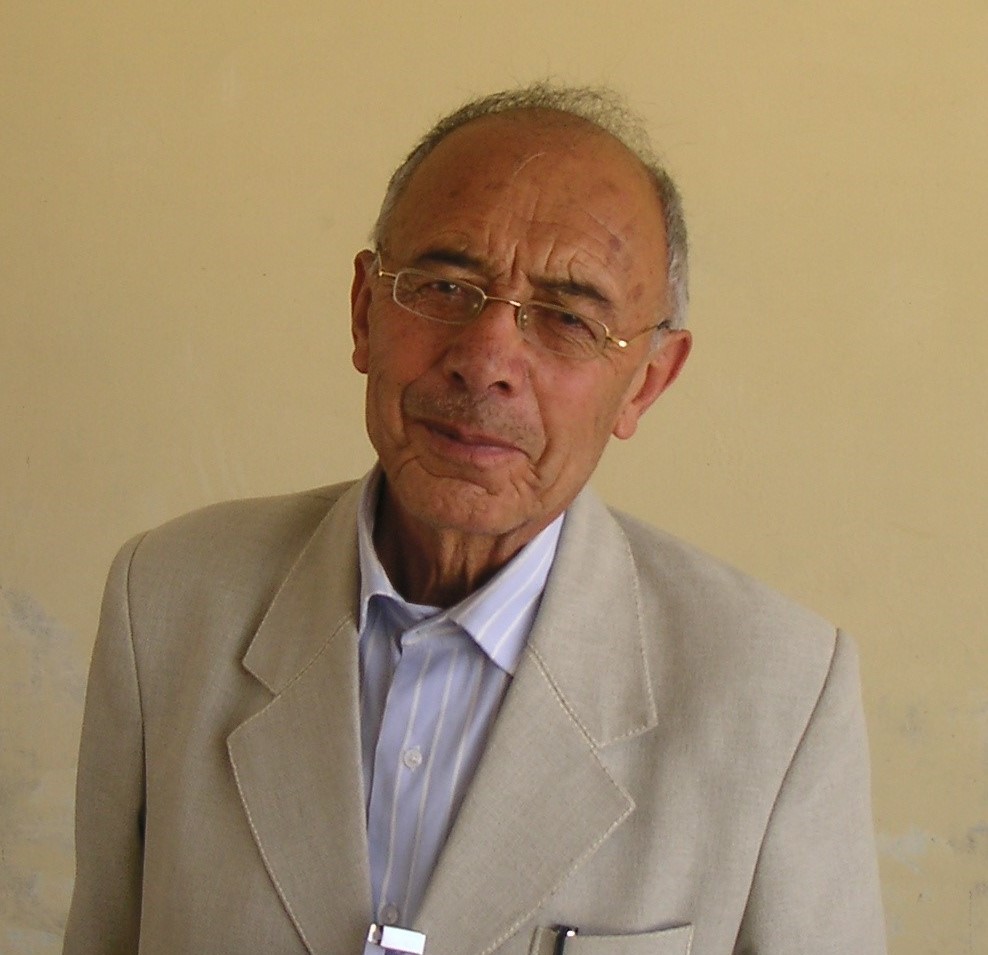
Abdul Ghani Sheikh in 2009
In 1989, Sheikh Sahib travelled to the UK for the IALS conference at the University of Bristol, which was organised by Dr Henry Osmaston. Although this was the fourth in the series of Ladakh studies conferences, it was the first to be held specifically under the auspices of the IALS. Sheikh Sahib presented a paper on “A Brief History of Muslims in Ladakh”. The other Ladakhi contributors in Bristol were Jamyang Gyaltsen, Dr Nawang Tsering, Nawang Tsering Shakspo, and Sonam Wangchuk (SECMOL).
Abdul Ghani Sheikh presenting in Bristol in 1989. John Bray on the left, Nawang Tsering Shakspo on the right.
Thereafter, Sheikh Sahib became a regular presenter at IALS conferences both in Ladakh and abroad. The last international conference in which he participated was in Rome in 2007. Always eager to expand his international horizons, he managed to stop over in Istanbul on the return journey and made contact with a Uighur friend who lived in Turkey but had long family associations with Ladakh.
Shiekh Sahib’s list of IALS publications is representative of his special interests. By virtue of his background, he naturally placed a particular focus on the history of Ladakhi Muslims and on Ladakh’s relationships with Central Asia and other neighbouring regions. However, he always took a broad view of Ladakhi society. His other writings included a biography of the Ladakhi Buddhist leader Sonam Norboo (1909-1980) and he often expressed appreciation for the contributions of the Moravian community.
Abdul Ghani Sheikh with Radhika Gupta at the IALS conference in 2009. Christian Jahoda and Kurt Tropper in the background.
In the early 2000s, Sheikh Sahib served as the Hon Secretary of the IALS’s Ladakh Committee. I particularly remember working with him to secure the participation of two Balti scholars, Syed Bahadur Ali Salik and Ghulam Hasan Hasni, at the IALS conference in Kargil in 2005. This involved writing invitation letters and supporting documentation to the Indian High Commission in Islamabad as well as the Pakistani High Commission in New Delhi and – at the very last minute – the then Indian Foreign Minister Natwar Singh. Eventually, we were successful but the two Baltis only arrived in Kargil on the very last day of the conference.
Over the years, many of us benefitted from the hospitality of Sheikh Sahib and his family at the Yasmin Guesthouse, now the Grand Yasmin Ladakh, near Fort Road. Whether at his home or in one of Leh’s restaurants and coffee houses, it was always a delight to meet him. He was consistently unassuming, always perceptive, sometimes quite sharp in his observations. We have lost one of the best of friends.
Abdul Ghani Sheikh’s publications under the auspices of the IALS
1995. “A Brief History of Muslims in Ladakh.” In Recent Research on Ladakh 4 & 5, pp. 189-192. Edited by Henry Osmaston and Philip Denwood. London: School of Oriental and African Studies; Delhi: Motilal Banarsidass.
1996. “Some Wellknown Adventurers of Ladakh.” In Recent Research on Ladakh 6, pp. 231-238. Edited by Henry Osmaston and Nawang Tsering. Bristol: Bristol University Press; Delhi: Motilal Banarsidass.
1997. “Ladakh’s Relations with Central Asia.” In Recent Research on Ladakh 7, pp.447-456. Edited by Thierry Dodin and Heinz Räther. Ulmer Kulturanthropologische Schriften Band 8. Ulm: Abteilung Anthropologie, Universität Ulm.
1999. “Economic Conditions in Ladakh during the Dogra Period.” In Ladakh: Culture, History and Development, between Himalaya and Karakoram. Recent Research on Ladakh 8, pp. 339-349. Edited by Martijn van Beek, Kristoffer Brix Bertelsen and Poul Pedersen. Aarhus: Aarhus University Press.
2007. “Transformation of Kuksho Village.” In Recent Research on Ladakh 7, pp. 163-170. Edited by John Bray and Nawang Tsering Shakspo. Leh: Jammu & Kashmir Academy of Art, Culture & Languages.
2009. “Kargil from the Perspective of Historical Travellers and Government Officials.” In Recent Research on Ladakh 2009, pp. 39-45. Edited by Monisha Ahmed & John Bray. Kargil & Leh: International Association of Ladakh Studies.
2009. “The Traditions of Sufism in Ladakh.” In Mountains, Monasteries and Mosques. Recent Research on Ladakh and the Western Himalaya, pp. 131-139. Edited by John Bray & Elena De Rossi Filibeck. Supplement No. 2 to Rivista degli Studi Orientali 80 (New Series). Pisa & Rome: Sapienza, Università di Roma, Dipartimento di Studi Orientali.
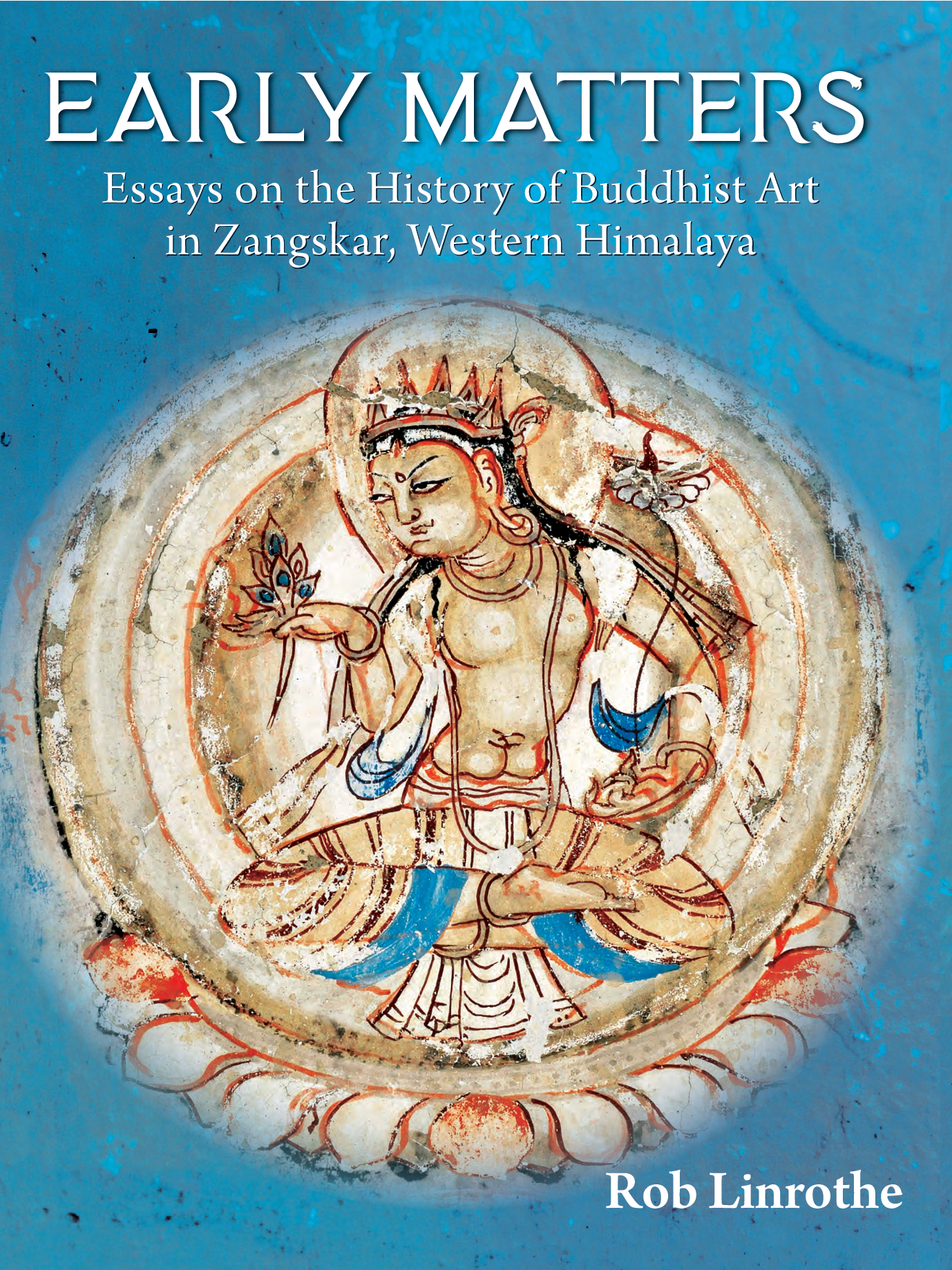
we like to draw your attention to the recently released book “Early Matters: Essays on the History of Buddhist Art in Zangskar, Western Himalaya” by Rob Linrothe. Please find the description below.
Early Matters: Essays on the History of Buddhist Art in Zangskar, Western Himalaya by Rob Linrothe
Studio Orientalia (New Delhi), 2024, xiv+510p., (4)col. maps, full of col. illus., bib., ind., 31´24cm.ISBN 9788196871567 US$90
This book is focused on the art in the remote valleys of Zangskar, a region of the Union Territory of Ladakh in northern India. It proposes that, first, the people and institutions in Zangskar produced a treasury of understudied Buddhist art in the form of architecture, sculpture, and painting and that, second, examination of this corpus models the formation of early visual culture in the western Himalaya as a whole. Its chapters provide correctives to the reduction of this region to a miniature or provincial Tibet, particularly in the early periods of extant sculpture (between the seventh and eleventh centuries) and of painting (tenth to thirteenth centuries). It locates Zangskar as its own center intersecting and in contact with a range of Buddhist visual production sites surrounding it in all directions, including greater Kashmir, Khotan, Central Asia, northern and eastern India, Tibet and western Nepal. The analysis of early Zangskari Buddhist images is a much more complex—and interesting—story of cultural development and inspiration than the simplified “Indo-Tibetan” narrative which ignores the agency of Zangskar’s artists, merely attributing forms and objects to invisible Tibetan hands.
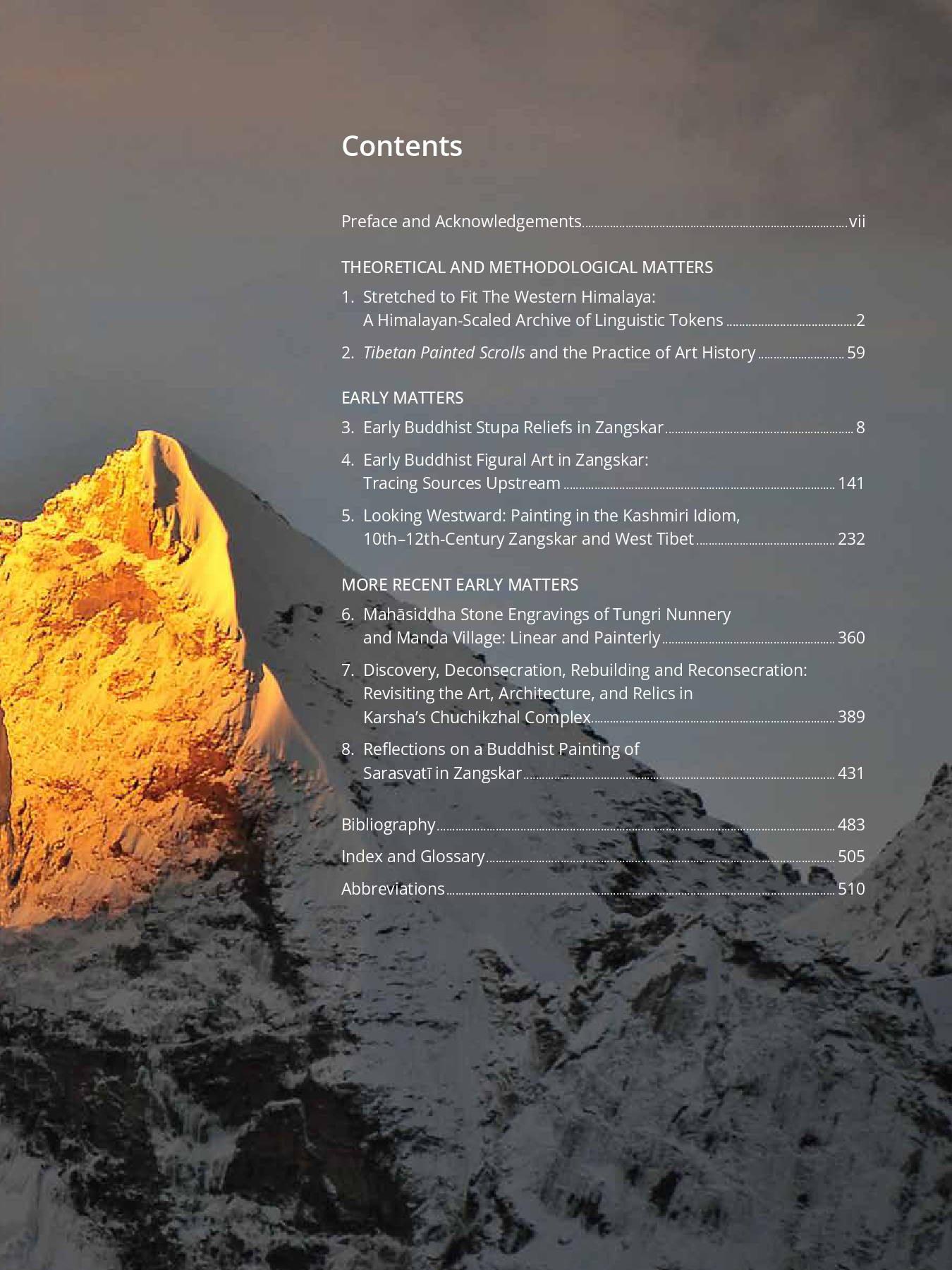
The first chapter of Part I, “Theoretical and Methodological Matters,” takes a historiographic approach to highlight misunderstandings in regional nomenclature. The second chapter reconsiders the relevance of the influential Tibetologist and art collector, Giuseppe Tucci, in the practice of art history on Tibet and the western Himalaya. The three chapters of Part II, “Early Matters,” successively examine the earliest low relief stupa engravings on stone in Zangskar and Ladakh, the early figural carvings and paintings in the area, and the important early Esoteric Buddhist sculptural and painted program at the Malakartse Khar site in Zangskar. The latter are compared to other extant sites in western Tibet. The sixth chapter, the first of three in Part Three, examines two radically different sets of Mahasiddha stone carvings in two neighboring villages of Zangskar. Chapter 7 recounts the discovery, recovery, expansion, and renovation in the twentieth and twenty-first centuries of twelfth- to fifteenth-century structures, paintings, sculptures, and other finds at Karsha village by the Karsha Lonpo Sonam Wangchuk and his family. The final chapter considers a single painting of Sarasvati of late fifteenth- or early sixteenth-century date preserved in the Phugtal Monastery of Zangskar, conjuring the embedded religious and social significance to its monastic sponsor who is depicted at the bottom of the painting. The 585 illustrations, with many details, represents an expansive documentation of culture heritage currently threatened by climate change and the lack of protection for objects traditionally displayed in open view.
(Book + FedEx delivery USD 133 for Germany, France, Austria, UK and USA)
We are happy to announce that the publication “Alchi, Ladakh’s Hidden Buddhist Sanctuary”, which has been published in two volumes in 2023, is now also available through open access. You can find the links to the publication below the book description.
“Alchi, Ladakh’s Hidden Buddhist Sanctuary
The monastic complex of Alchi is undoubtedly one of the most important and fascinating monuments preserved in the Himalayas. With its earliest monuments dating from the late twelfth to the mid-thirteenth centuries, it provides unique insight into the Buddhist culture flourishing at that time.
Through a detailed analysis of the architecture, sculptures and murals in their context, their interrelationship to each other and to Tibetan textual sources likely known at that time the publication offers a deeper understanding of the monuments religious environment. A reassessment of some of the inscriptions preserved at the site provides new insights into the historical circumstances of the temple’s construction.
This two volume publication builds on and includes an updated version of the Sumtsek book by Roger Goepper, covers all early remains of the Alchi Choskhor, and still relies on the quality of Jaroslav Poncar’s early documentation for all main monuments. Holger Neuwirth and Carmen Auer contributed on the architecture and all plans, and Rob Linrothe and Nils Martin contributed new studies on the lineage depiction and the previously not recognised foundation inscription of the Sumtsek.”
John Clarke, who passed away in September, spent his entire professional life at London’s Victoria and Albert (V&A) Museum. His special field of interest was the study of the art of metalworking in Ladakh and Tibet. With this note, I wish to celebrate his contribution and point to his academic legacy.
John joined the V&A in 1979. Alongside the day-to-day demands of his regular work, he was encouraged to conduct academic research, and between 1986 and 1991 made a series of visits to Ladakh, Dharamsala, Nepal, Tibet and Bhutan. His journey to Ladakh during this period served as the foundation of much of the rest of his life’s work. Crucially, he was able to travel to the village of Chiling on the Zangskar river. The village’s inhabitants are said to be the descendants of a group of Newari craftsmen who came to the region in the 17th century at the invitation of King Sengge Namgyal (r.1616-1642). Their first tasks included the construction of the copper-gilt images of the Maitreya at Basgo monastery and the Buddha in Shey. Ever since, Chiling craftsmen have specialised in the working of copper, bronze, silver and gold. They are particularly well-known for the production of spoons, ladles, teapots and beer jugs as well as religious objects such as copper-gilt chortens for monastic and family temples. John was able to observe their work at first hand.
I first met John in 1989 when IALS founder Henry Osmaston convened the fourth Ladakh Studies conference at the University of Bristol. Before the main conference, we organised a study day in London, and John arranged for us to see behind the scenes at the V&A. I remember being impressed at the sheer extent of the collection of Ladakhi and Tibetan artwork that is kept in storage, crammed closely together to save space. At the conference itself, John presented “A survey of metalworking in Ladakh”, and this was published in the conference proceedings in 1995. The paper discussed the roles of blacksmiths across Ladakh and of goldsmiths in Leh as well as the Chiling craftsmen. John noted that copper- and goldsmiths in Ladakh enjoyed a higher social status than their counterparts in Tibet. Strikingly, he was able to document the links between successive generations of Chiling craftsmen with key patrons, notably the Kalon family in Changspa.
John’s work on Ladakh evolved into a chapter of his Ph.D dissertation at the School of Oriental and African Studies in London. The dissertation, which he defended in 1995, is available online at the British Library’s EThOS website, and carries the title “A Regional Survey and Stylistic Analysis of Tibetan Non-Scultural Metalworking, c.1850-1959.” It is based on a combination of field research, a close examination of metal artefacts from the region that are held in European museums, and a careful reading of travel accounts by Western travellers since the 19th century. The thesis covered a broad geographical range from Central and Southern Tibet to Kham and neighbouring regions in China and Mongolia, as well as Ladakh and Bhutan. John argued that the style of metalwork in these regions pointed to a broad cultural unity, but at the same time he was able to identify distinct regional variations in style.
In 1999 John made a further contribution to an IALS publication, a chapter on “The Tibetanisation of European Stoves in Ladakh”, which appeared in the proceedings of our eighth conference, which had been held in Aarhus (Denmark) two years earlier. Here he discussed the “hybridisation” of iron stoves introduced to Ladakh by Moravian missionaries. The original rather plain metal stoves have evolved into highly decorated artefacts decorated by local blacksmiths and goldsmiths using traditional motifs such as the ‘wish-fulfilling jewel’.
John made one more contribution to Ladakh studies with a chapter in Ladakh, Culture at the Crossroads, edited by Monisha Ahmed and Clare Harris (2005). Meanwhile, he continued to develop his expertise across the wider Tibetan cultural region, and his curatorial responsibilities extended beyond the Himalayas to Southeast Asia. He became the Lead Curator for the Robert H.N. Ho Family Foundation Buddhist Art Galleries. These first opened in 2009 but closed temporarily in 2013 ahead of an extended period of building work. In 2015 the V&A opened a new gallery devoted to the image of the Buddha, and the other galleries reopened in 2017. As John explained in a blog article, he gave careful consideration on how best to present the Buddhist religious heritage in the context of a secular museum. A key objective of the galleries is to make this heritage accessible to a wider Western audience without compromising the religious integrity of the artefacts displayed.
John was a regular contributor to academic seminars, conferences and workshops relating to Tibet and the Himalaya. He was himself the organiser of a major conference on Buddhist sculpture held at the V&A in 2010, and edited the proceedings. Other activities included serving as Visiting Professor at the University of Northumbria, which has become an important centre for the study of Asian art. Until his death, he was working on a proposed exhibition on the art of Buddhist Tantricism, to be held at the V&A in 2023.
At least two of his conference contributions are available online. The first is a brief presentation on “The Trance Walking Tradition of Tibet” presented at the Third International Conference on Vajrayāna Buddhism held in Bhutan in 2019. The second is a one-hour lecture on “Collecting Tibet at the South Kensington Museum: the legacy of the 1904 expedition and beyond,” which was presented to the Royal Asiatic Society in early 2019. In the Royal Asiatic Society lecture, John discusses the sensitivities associated with the provenance of the V&A’s Tibetan collection. Many of the most important items were acquired as a result of Col. Francis Younghusband’s military expedition to Lhasa in 1903-1904, though there have also been several other sources. His slides for the lecture include an image of a thangka from Western Tibet collected in the 1850s by the Schlagintweit brothers who spent several months in Ladakh during the same period. He also showed an image of an ornate teapot, originally from Hemis monastery, which came from the bequest of British viceroy Lord Curzon. As John briefly acknowledged, the teapot served as a reminder of his own earlier researches in Ladakh. He concluded the lecture by presenting an image of a 15th century Sino-Tibetan brass sculpture of the Mahasiddha Virupa, which he had himself been able to acquire for the V&A from a museum in the west of England. This lecture reflects John’s deep engagement with the V&A’s Tibetan and Himalayan collection over several decades. In that respect, it perhaps serves as a kind of colophon to his own career.
In the last 18 months John had to take frequent sick leave in order to receive treatment for lymphoma, a cancer of the blood cells. At first the treatment seemed to go well, and John responded with what one of his colleagues calls his “characteristic quiet resilience”. He was looking forward to returning to work. Sadly, this was never to be.
Select publications by John Clarke
1989. “Chiling, a Village of Ladakhi Craftsmen and their Products.” Arts of Asia 19, No. 3, pp. 128-141.
1992. “A Group of Sino-Mongolian Metalwork in the Tibetan Style.” Orientations 23, No. 5, pp. 65-75.
1995. “Survey of Metalworking in Ladakh.” In Recent Research on Ladakh 4 & 5, pp. 9-17. Edited by Henry Osmaston and Philip Denwood. London: School of Oriental and African Studies; Delhi: Motilal Banarsidass.
1995. A Regional Survey and Stylistic Analysis of Tibetan Non-Sculptural Metalworking, c. 1850-1959. 2 vols. PhD dissertation. London: School of Oriental and African Studies
1997. Tibet, Caught in Time. Reading: Garnet Publishing Ltd.
1998. “Hindu Trading Pilgrims.” In Pilgrimage in Tibet, pp. 52-70. Edited by Alex McKay. Richmond: Curzon.
1997. “Regional Styles of Metalworking”. In Tibetan Art, Towards a Definition of Style, pp. 278-289. Edited by Jane Singer and Philip Denwood. London: Calman and King.
1998. “Hindu Trading Pilgrims.” In Pilgrimage in Tibet, pp.5 52-70. Edited by Alex McKay. Richmond: Curzon.
1999. “The Tibetanisation of European Steel Stoves in Ladakh.” In Ladakh: Culture, History and Development, between Himalaya and Karakoram. Recent Research on Ladakh 8, pp. 58-71. Edited by Martijn van Beek, Kristoffer Brix Bertelsen and Poul Pedersen.Aarhus: Aarhus University Press.
2001. “Ga’u–The Tibetan Amulet Box.” Arts of Asia 31, No. 3, pp. 45-67.
2002. “Metalworking in dBus and gTsang, 1930-1977.” Tibet Journal 27, Nos 1-2, pp. 113-152.
2004. Jewellery of Tibet and the Himalayas. London: Victoria and Albert Museum.
2005. “Metalworking in Ladakh”. In Ladakh Culture at the Crossroads, pp. 44-55. Edited by Monisha Ahmed and Clare Harris. Bombay: Marg.
2011. “Non-sculptural Metalworking in Eastern Tibet 1930-2003.” In Art in Tibet, Issues in Traditional Tibetan Art from the Seventh to the Twentieth Century, pp. 171-182. Proceedings of the 10th seminar of the International Association for Tibetan Studies. Edited by Erberto Lo Bue. Leiden: Brill.
2013. “A New Image of the Mahasiddha Virupa: a Major Addition to the Corpus of early Fifteenth-century Bronzes.” Art of Merit. Studies in Buddhist Art and its Conservation: Proceedings of the Buddhist Art Forum 2012, pp. 241-250. Edited by David Park, Kuenga Wangmo and Sharon Cather. London: Archetype Publications
2017. “The New Robert H. N. Ho Family Foundation Galleries of Buddhist Art at the Victoria and Albert Museum.” Orientations 48, No. 5.
2019. “Introduction to Papers on Buddhist Sculpture Given at, or Arising from, the Buddhist Sculpture Symposium Held at the Victoria and Albert Museum in 2010.” Inner and Central Asian Art and Archaeology 2, 127-132. Special edition on New Research on Central Asian, Buddhist and Far Eastern Art and Archaeology. Edited by J.A. Lerner and A.L. Juliano. Turnhout: Brepols.
2020. “On the Road Back to Mandalay: The Burmese Regalia – Seizure, Display and Return to Myanmar in 1964.” In Returning Southeast Asia’s Past. Edited by Louise Tythacott and Panggah Ardiyansyah. Singapore: National University of Singapore Press.
The 150th birth anniversary of August Hermann Francke (1870-1930) falls on 5 November this year. In the light of more recent research, it is important to read Francke’s work critically. Nevertheless, there is no question of his status as a founding father of modern scholarship on Ladakh. With this short essay I present the main details of his life in order to put his contribution to Ladakh studies into context.
Francke was born in Gnadenfrei, in what was then south-east Germany, now part of Poland. From his childhood he was brought up as a member of the Moravian Church (Herrnhuter Brüdergemeine). He was trained as a primary school teacher and taught at a boarding school for children of missionary parents before himself being called to the Moravian mission field in Ladakh. In 1896 he arrived in Leh. The following year he married Theodora (‘Dora’) Weiz, who had been sent from Germany to join him. Dora was herself the daughter of a missionary to South Africa. They had three children, all born in India.
Francke and his family c. 1908.¹
Francke’s career as a full-time missionary was relatively short. He served in Leh for three years, before setting up a new mission at Khalatse in 1899. He was based there until 1906 and then moved to Kyelang in Lahul, now part in the Indian state of Himachal Pradesh. In 1908, he and his family had to return home to Germany because of Dora’s ill-health.
Those early years in India laid the foundations of Francke’s future career as a scholar. An earlier missionary, Heinrich August Jäschke (1817-1883) had translated most of the new Testament into a simple form of literary Tibetan, as well as preparing a Tibetan-English Dictionary (1881). Together with his German and Ladakhi colleagues, Francke was part of a team that began work on the translation of the Old Testament. At the same time, he was keen to promote the study of the spoken languages of the region. Working with local Christians, he prepared versions of the Gospel of St Mark in colloquial Ladakhi as well as the three languages of Lahul: Bunan, Tinan and Manchad.
The La dwags kyi ag bar.²
Francke’s linguistic researches led him to the study of Ladakhi folksongs and then to the Kesar epic. At the same time, he became interested in the history of Ladakh, drawing on the La dwags rgyal rabs (the royal chronicles of Ladakh), as well as rock inscriptions and oral history. Starting in the 1890s, he published a series of scholarly papers with learned societies in India, Britain, Germany and Finland. He also brought out local publications from the mission press in Leh, including the La dwags kyi ag bar, a monthly newspaper that was written in the Tibetan script in a colloquial style of language to make it as widely accessible as possible. In 1907, he published A History of Western Tibet, the first English-language history of the region.
These publications brought him to the attention of the Archaeological Survey of India (ASI), a British-Indian government department based in Simla. In 1909, Francke returned to India for just over a year, leaving his family in German, and undertook a pioneering archaeological research expedition to the Himalayan regions of Kinnaur, Spiti and Ladakh. Francke’s assignment with the ASI led to the publication of his two-volume Antiquities of Indian Tibet (1914, 1926)
The cover of a pamphlet published by Francke in 1911, illustrating his adventures while researching Tibetan and Ladakhi history.³
After returning to Germany in 1910, Francke spent three years at his home in Germany, writing up his historical researches and at the same time continuing with the Tibetan translation of the Bible in association with the London-based British and Foreign Bible Society (BFBS).
This combination of interests led him to undertake what proved to be his final journey to India in 1914. This time, instead of travelling by sea, he went overland via Russia and Chinese Turkestan (now Xinjiang). His intention was to travel via Ladakh to where he would study the Lhasa dialect of Tibetan. However, his timing proved to be particularly unfortunate. While still in Chinese territory, he heard distant rumours of the outbreak of the war but guessed that Germany and Britain would be fighting together against Russia. It was only when he arrived in Leh in September 1914 that he discovered that the two countries were on opposite sides, and that he was now officially classified as an enemy alien. To his chagrin, he was sent to an internment camp in Ahmednagar, before being repatriated to Germany via Holland in 1916. He then served as an interpreter at a camp for Indian prisoners of war in Romania before himself being imprisoned a second time at the end of the war.
Francke at the internment camp in 1915, from a sketch by his Hungarian fellow internee Labay.⁴
Francke spent much of the final decade of his life in Berlin where he became the University’s first professor of Tibetan in 1925. In these years, he continued the same combination of interests as before, publishing scholarly articles on Ladakhi history, while continuing work on the translation of the Old Testament in association with the Ladakhi Christian minister and scholar Joseph Gergan (1878-1946). He also resumed his connections with scholars in Britain and India. The second volume of Antiquities of Indian Tibet, which had been delayed by the many disruptions of the First World War, finally appeared in 1926. This volume includes a translation of the La dwags rgyal rabs, and may be Francke’s single most important contribution to the scholarship of Ladakh
Sadly, Francke’s scholarly career was cut short when he was suddenly taken ill in early 1930: he died in Berlin’s Charité Hospital, still aged only 59. At his death he left several projects unfinished. These included the projected third and fourth volumes of Antiquities of Indian Tibet, which he was working on with the retired Indian Civil Service officer H. Lee Shuttleworth. He also planned the publication of the texts of a series of Ladakhi marriage songs, a task that was finally accomplished under the editorship of Elena De Rossi Filibeck in 2018. At the same time, he was still studying the collection of archaeological artefacts that he had gathered in Xinjiang in 1914: this collection is at the Museum Fünf Kontinente in Munich and has still not been fully evaluated.
Francke’s papers are scattered across a number of archives, notably at the State Library in Berlin and the Leipzig University Library. Hartmut Walravens & Manfred Taube (1992) have prepared an invaluable bibliography of Francke’s publications and unpublished papers. More recently, the French scholar Jonathan Guyon Le Bouffy has been working on a project to put as much as possible of Francke’s work online.
Francke’s contemporaries valued him not only for his scholarship but also for his personal warmth and a sense of humour that still comes across in his numerous publications. This warmth extended to his Ladakhi colleagues whom he regarded as his friends, and not merely as disciples or informants. Considering the difficulties under which he worked, his output was extraordinary. There is still much to be learnt from his legacy.
¹ Courtesy of Martin Klingner. ² Courtesy of Herrnhut Museum für Völkerkunde. ³ Source: Francke (1911). Tibetische Geschichtsforschung und wasman dabei erleben kann. Herrnhut: Verlag der Missionsbuchhandlung. ⁴ Source: Francke (1921). Durch Zentralasien in die indische Gefangenschaft. Herrnhut: Verlag der Missionsbuchhandlung.
Select bibliography
Bray, John. 2008. “August Hermann Francke’s Letters from Ladakh 1896-1906. The Making of a Missionary Scholar.” Tibet Journal 33, No.1, pp. 3-28.
______. 2015. “A.H. Francke’s Last Visit to Ladakh: History, Archaeology and the First World War”. Zentralasiatische Studien 44, pp. 147-178.
______. 2019. “Ladakhi Knowledge and Western Learning: A.H. Francke’s Teachers, Guides and Friends in the Western Himalaya.” In Perspectives of Tibetan Culture. A Small Garland of Forget-me-nots Offered to Elena De Rossi Filibeck. Edited by M. Clemente, O. Nalesini & F. Venturi. Revue d’Etudes Tibétaines 51, pp. 39-72.
De Rossi Filibeck, Elena (Ed.) 2018. Manuscripts of “Tibetan Marriage Songs” from Ladakh. August Hermann Francke’s Legacy in the Tucci Collection, Rome. With an essay by John Bray. Serie Orientale Roma. New Series 11. Rome: Scienze e Lettere.
Francke, A.H. 1905-1941. A Lower Ladakhi Version of the Kesar Saga. With an introduction by Suniti Kumar Chatterji. Calcutta: Royal Asiatic Society of Bengal.
Francke, A.H. 1907. A History of Western Tibet. London: S.W. Partridge.
Francke, A.H. 1914, 1926. The Antiquities of Indian Tibet. 2 vols. Calcutta: Archaeological Survey of India.
Walravens, Hartmut & Taube, Manfred. 1992. August Hermann Francke und die Westhimalaya Mission der Herrnhuter Brüdergemeine. Mit einem Beitrag von Michael Hahn. Stuttgart: Franz Steiner Verlag.
“I am saddened to learn the passing away of Shri Tashi Rabgias, the patron of International Association for Ladakh Studies (IALS) this morning. I extend my most heartfelt sorrow and condolences on the loss of Ladakh’s historian and scholar whose contribution to language, literature and history of Ladakh is immense. It is an irretrievable loss to the people of Ladakh. May he attain Nirvana!”
Historically, neither infectious diseases nor quarantine are new to Ladakh or the wider Himalayan region. At first sight, this is a depressing topic for research. However, closer examination points to encouraging evidence of human ingenuity. Above all, it reminds us – if any reminder is needed – of the benefits of modern medical care.
Some of the most vivid source material concerns smallpox. Dr Henry Cayley (1834-1904), a member of the Indian Medical Service, was the first fully-trained Western doctor to work in Ladakh: he came to Leh in 1867 as a British “officer on special duty” and ran a clinic alongside his main work, which was to monitor the Central Asian trade routes. He wrote that he saw no case of smallpox in that year but that “ten years ago it spread through the whole country, and killed numbers”. He goes on to explain that the Ladakhis had practised a stark form of social distancing:
In former years the custom was to expose the patients with the disease out on the mountain sides, where the friends brought them food, &c. until they either died or got well. It was a somewhat cruel, but, at the same time, admirable, plan for lessening the spread of the disease: and in this climate it would really be better for the sick to be out in the open air, than shut up in a close dwelling.
On a happier note he reported that the whole population had been “inoculated by the Lamas” during that period. Since then, the disease had not occurred, except for a few cases in 1866, and the dread of the disease had greatly diminished.
It is not clear precisely what Cayley means by “inoculation”. In the late 18th century the British doctor Edward Jenner had pioneered the process of cowpox vaccination. The East India Company veterinarian William Moorcroft, who visited Ladakh in 1820 and 1821, tried to introduce vaccination against smallpox, but was unsuccessful because he was unable to obtain a sufficient quantity of active vaccine from his friends in India. Meanwhile, as Lobsang Yongdan (2016) has shown, the Tibetan scholar Jampel Tendzin Trinlé (1789-1839), widely known as ‘Tsenpo’, wrote about vaccination in Jenner’s sense, as early as the 1830s. However, the Ladakhi lamas who were inoculating in the 1850s may have been practising variolation, a technique whereby doctors immunize an individual against smallpox with material taken from a patient in the hope that a mild but protective infection would result.
In any case, both Western and local practitioners combined to spread knowledge of Jennerian vaccination in the Western Himalayan region from the mid-19th century onwards.
Another example from 1867, the year that Cayley was writing from Ladakh, concerns the Moravian missionary Eduard Pagell (1820-1883) who served in Pooh, Kinnaur. In February 1867 a messenger from the Totso valley in the neighbouring region of Western Tibet arrived to say that the area was suffering from a smallpox epidemic, which had already wiped out several families. He asked the missionary to come to their aid or no one would be left at all.
Pagell had himself been sick in bed for three days but he duly sent out on the five-day journey to Totso. In one village of 23 houses, 60 people had caught the disease and all but a few had died. In another place, those infected by the disease had taken refuge in a cave some distance away – following the same ‘quarantine’ technique as the Ladakhis – where they languished without any care at all. Pagell gave what help he could, visiting 12 villages and vaccinating 639 people.
On this emergency visit, Pagell, was welcomed wherever he went and many of his patients recovered but he was never able to repeat the journey. When he tried to do so in the summer of 1867, he found that the Tibetans had broken bridges on the main paths and placed watchmen at the border with orders to shoot anyone who tried to enter the country from Kinnaur: the whole country was in quarantine.
In Ladakh, both the knowledge and the practice of vaccination continued to spread. In 1880 British Joint Commissioner Ney Elias (1844-1897) reported that a monk named Sonam Tandup had made a practice of obtaining smallpox vaccine from the British dispensary. Travelling from place to place during a great part of the year, he had conducted 634 vaccinations in 1877, 347 in 1878 and 445 in 1879. He received no salary, and Elias suggested that he should be given Rs 15 for his work over the previous year.
Today, we again need to implement quarantine and social distancing but smallpox belongs to the past. One day – we hope soon – Covid-19 will likewise be a distant historical memory
References
Bray, John. 2015. “Dr Henry Cayley in Ladakh: Medicine, Trade and Diplomacy on India’s Northern Frontier.” In Tibetan and Himalayan Healing. An Anthology for Anthony Aris, pp. 81-96. Edited by Charles Ramble and Ulrike Roesler. Kathmandu: Vajra Books.
______.1992. “Christian Missionaries on the Tibetan Border: the Moravian Church in Poo (Kinnaur), 1865-1924.” In Tibetan Studies, pp. 369-375. Edited by Shoren Ihara and Zuiho Yamaguchi. Narita: Narita Institute for Buddhist Studies.
Lobsang Yongdan. 2016. The Introduction of Edward Jenner’s Smallpox Vaccination to Tibet in the Early 19th Century. Archiv Orientální 84: 577-593.




 International Association for Ladakh Studies (IALS)